What I learnt this week: Balancing proper procedure with paediatric passion #WILTW

This is the tweentieth #WILTW

In my humble opinion the Royal College of Paediatrics and Child Health have been very lucky. On Tuesday an Extraordinary General Meeting took place in regard to the governance and trustee structure which would lead to an opening up an arm of the RCPCH to all child health professionals. Details on the proposals can be found here

The outcome of the EGM was that the Foundation of Child Health was rejected. This is a great shame but I say the college has been lucky as I had half expected to see a Daily Mail headline:

Paediatric doctors feel they are more important than other health care professionals“.

Fortunately this angle was not taken, in fact there was virtually no media coverage. Those opposed cited a potential conflict if the paediatric ‘medical’ lead for the college and a non medical lead for the Foundation disagreed with each other which would be bad for public relations. Given the lack of interest in the event I’d be more worried that we have any paediatric voice at all!

My position was clear (from a previous Running Horse Group blog)

“This junior paediatrician  feels the concept of not moving in a direction that makes us multi-professional is almost absurd. I work on a daily basis with nurses, nurse practitioners, health care assistants and play specialists. I have also been part of a college structure which is bureaucratic, hierarchical and slow to react.”

Having passionate views about something makes you very dangerous. The moment you are not willing to pause and reflect is the moment you no longer have sound judgement. I therefore always make a big effort to step into other peoples shoes and aim to see things from their stand point.

Boat Land


cartoon courtesy of Dr. Hilary Cass

So, to be fair to those against the motion, there were some issues with the approach the College had taken. Changes to the governance structure were/are independent of the need for a Foundation of Child Health. Placing them together did cause confusion and potentially gave the impression of rail-roading the policy. The hosting of a significant event on a lunchtime, on a weekday, in London, did not invite a high turnout (to be fair the rules governing the college’s charitable status dictated that the vote needed to be in person). Finally at the hustings stage it would have been preferable to have an ‘against’ speaker as well as those ‘for’.

Adesthepoet


During the hustings the chair of the parent and carer’s group gave a emotional talk about her experiences of being a parent. She showed pictures of the twitter celebrity that is Adam Bojelian and the multiple interactions with doctors, nurses and therapists he has:

no child has ever died of too much communication between health and social care professionals

Her talk, followed by a focused argument from Dan Lumsden, the chair of the Trainees Committee, set out I think an unintentional confrontation between ‘procedure’ and ‘passion’. On one side, yes, there were some governance and policy issues at stake. Things could have been done differently in a very systematic fashion with extreme attention to detail. One the other we were deciding on a tone for the future. If the college of Paediatrics and Child Health are unable to embrace their fellow professionals and create a unified organisation to improve outcomes who else will?

I therefore found it very unnerving when the following was quoted as an argument AGAINST the changes…

“Management is doing things right; leadership is doing the right things.”

― Peter F. DruckerEssential Drucker: Management, the Individual and Society

A further speaker then worried that the potential non-elected nature of some of the trustees would risk a situation that is currently occurring in Hong Kong.

I spoke up in support of the motion but emotions are a strange thing. I have been more confident in a crowd of 1500+ than I was in front of the 100 or so in the audience. This was due to the fact, and I said this at the time, I was speaking against people who have mentored and supported me in the past. But it was also because I felt an overwhelming surge of righteousness about the motion; inflamed by an argument that the previous consultation was invalid due to its low turnout. This seems ridiculous given the equally poor responses rates for the Health and Social Care Act debate (context of table):

Voting in Health and Social Care Act

But also on reflection I was perhaps not as charitable as I should have been in regards to the comment comparing the college to the Chinese government.

Only time will tell as to the long term impact of this EGM. Many of the those voting no said they were voting against the lack of information  or “devil in the detail” provided. They weren’t against the Foundation in principle. Was this simply a case of the right thing to do but at the wrong time? I remain to be convinced. I worry that if the chance is to come again some equally obscure bye-law will be raised. If we are to be a multi-professional organisation then there will come a point that hierarchy and power is shared. That is unavoidable and no amount of procedure can bypass it.

Or maybe I just can’t see past my passion….

What did you learn this week? #WILTW

Additional Entry 11th October 2014

Please see the comments section. There has been some confusion I think about the Foundation being more important than the RCPCH. This is not the intention or the proposal. This diagram clarifies I hope:

Integrated College of Child Health

The Challenge of Change

Has Change Changed?

Has Change Day Changed?

Or has Change Day changed change?

At a recent strategy day for the 2015 event table ‘3’ contemplated questions that might be asked of the Change Day team in 5 years time. This simple sequence of questions raised a laugh at the time but has a serious point to make as to the challenge faced to continue the movement in a relevant way to health and social care in 2015. Change Day was envisaged as a social movement, not a solitary intervention, with a view to reaching out to staff in a way that would engage and inspire not direct and dictate. But because of this its very success became almost its worst enemy. Those who decided to pledge did so for reasons intrinsic to them and therefore the pledges were, by definition, very different. The sheer volume of pledges highlighted the fact that, while some pledges had obvious face value and clear outcomes, others did not. Quite rightly the dissonance between what, why and how pledges were being undertaken concerned those who felt uncomfortable without any tangibility in purpose.

“To the organisers of Change Day, you need a bit of cautious optimism. Don’t let the event be hijacked by people jumping on the bandwagon with pledges that raise questions along the lines of: “What have you been doing so long?” From Dr. Partha Kar: A note of caution about Change Day ” Health Service Journal March 2014

I’ll be honest – some of the pledges caused me conflict. I am a ‘quantitative’ personality.  My PhD research in medical education created measurable frameworks to bring together often qualitative attributes. Pledges such as “I will provide great care” weren’t quite what I had in mind when I first meet Stuart Sutton and Helen Bevan to discuss how Change Day would work.

But I have moved on from this state of mind. In large part due to Kate Granger  who reminded me that even the simplest thing in health and social care can be done badly. #hellomynameis a perfect of example of what some might see as a ‘quid pro quo’ in communication and yet it clearly isn’t. My own reflections on when I forgot to introduce myself made me realise it is not for me to say what others can and can’t pledge. It is their pledge. The purpose of change day was to engage in a non-hierarchical fashion. The very notion of telling people their pledges are worthless simply destroys that approach.

But what of ‘change’ itself. The term change is becoming increasingly poisonous. One delegate hit the nail on the head at an RCPCH event to assist educators in promoting and delivering change.

So a NHS Improvement Day? I feel that may well have created a similar backlash. So we decided on Change Day. But I acknowledge change is a challenging concept. Change itself is undergoing somewhat of a revolution at the moment. NHS IQ have released a white paper on the subject. It is worth a read. Some will find its ideas off putting – its use of the term ‘radical’ uncomfortable. Recent discussions on twitter and other fora have identified an important engagement principle at stake here. It is not a black and white case of bad vs good. There is a danger that camps may start: radical vs non-radical, insiders vs outsiders. George Julian recently raising the issue of Courageous Challenge versus Conformist Control. A vital theme is explored here and one we must all heed: perceptions and motivations of change are different. Health and Social care is not a homogenous beast but a vibrant mix of personalities and approaches. And this is why I see see Change Day not being the same thing to all people. We are not a small group of individuals telling people what to do but a large network of professionals and patients wanting to make a difference in their own localities. The hubbies are a fantastic example of how a shared value can bring people together – student nurses, managers, patient advocates, junior doctors – working in a capacity that wouldn’t have been plausible a decade ago. But some of those same people are enthusiastic about change in a way that is very different from others. In fact within the ‘change’ community I see grumblings about the importance, or not, of wearing public passion on your sleeve. Twitter, in particular, has enabled some people to be very openly proud about their values. Their followers applaud this public display of strength and candour and affirm it. Others can’t stand the pomposity of it all and ignore or deconstructively challenge. And some where in between a group of people who share similar passions often find themselves arguing against each other. The fast paced nature of the world we live in creating conversations and dialogues in formats not always suited to appreciate both sides of the debate. Having recognised my own passive aggression on twitter I really think we could all benefit from a look at our own approaches to the change debate and this is something the Change Day team must be very cogniscent of. We are running the risk of creating radicals within radicals if we are not careful.

Change Day Triangle

As well as determining a common language of change we are also challenged with looking at what change day has actually achieved. I was very deliberate at the start of the piece. Change Day is a social movement – it is not a medical intervention. That does not mean it is not being evaluated but it does mean that it is not a simple case of saying; “This went in and this came out”. I use the following tweet to explain the complexity of the challenge:

A learning package was created on the basis of Change Day which resulted in one doctor changing their practice for the benefit of a patient. This is a very difficult thing to record (and if I had not seen the tweet I would have missed it). But it is a very real difference for the persons involved. My own pledges have been around patient experience. Can I truly say I have changed anything. On paper – no. But around the department many know of the unpleasant nature of flucloxacillin and I’ve seen staff speed up the extraction of children from spinal boards as they have heard of my experiences. Please don’t get me wrong. I am not making excuses for why (to some) we have little definitive to show (we do have a developing, long term evaluation strategy which involves a PhD on our work). We must acknowledge this is not a Beta-Blocker trial but an ongoing complex intervention spanning years.

I think an important lesson for us all is to be  respectful of others ‘change’ journeys as everyone moves at very different speeds. The emotions and passions surrounding the NHS sometimes make it easy to forget we are all part of this great institution whether you are a health and social care professional, patient or member of the public. I personally welcome the challenge of change and hope I, and others, respond in a way that is considerate and constructive regardless of the medium used.


This blog is my personal opinion and has has not been reviewed or endorsed by other Change Day Team members. I welcome comments, critical or otherwise, from anyone with questions about Change Day. 


What I learnt this week: What you see is maybe not what I see? #WILTW

This is the nineteenth #WILTW

A significant proportion of patients in health care services are seen by multiple health care professionals (excepting primary care and out-patients). Acknowledging some patients do deteriorate rapidly, generally there are the same clinical signs and symptoms to be observed regardless of the different staff seeing them. It is well recognised however that patients can have many clinical encounters before someone finally recognises they are seriously ill [1].  The fact that some clinicians see different ‘things’ in patients is not unsuprising. There are some clinical signs which are very subtle, such as work of breathing and fine movements, which require training and repeated exposure to be able to put into a context which makes pattern recognition obvious.

However others are more clear; physiological features such as heart rate and breathing rate being fixed signs which should not differ when examined by different individuals. To be clear I am not pondering over gut feeling here. The literature on the use of ‘gestalt‘ by experienced clinicians to recognise serious illness is substantial but this is not about subtle signs or intuition. How is it that in the same time span a patient who has clear features of illness may be recognised by one person but not by another? Experience and knowledge play a role but continued failure to recognise significant illness even by experienced  professionals represents a significant challenge for the health care community.

I have a research interest in the educational use of clinical video cases. This hat often collides with my clinical practice hat when system errors occur in the recoginition of illness in children. This dilemma of why a particular patient isn’t recognised as being ill (or the converse – when someone is overtreated as being very unwell when in fact they weren’t) is an important issue as is often the root cause of communication problems between departments in hospitals.

The video below was consented for general viewing by the patients’ mother (appropriate hospital and national guidance was followed). I use it (hopefully!) as a potential grey case to highlight how the same clinical features can be interpreted differently . I’m hypothesising there maybe differences in determining which are the salient clinical signs in this case. Please feel free to leave your thoughts in the comments section (appreciating previous comments may bias you so try not to look!). Regardless of whether I’m right or wrong I hopefully will learn something I can feed back on in the future!

[Oxygen Saturations 96% – Heart Rate 170 – Temperature 36.4]

What have you learnt this week? #WILTW

[1] RCP NEWS standardising assessment of acute illness severity 

What I learnt this week: Am I really learning..? #WILTW

This is the eighteenth #WILTW (and a little delayed due to working the weekend!)

How many times do you need to experience something for you to learn from that experience? In medicine health care professionals will often refer to ‘sentinel’ events. A clinical incident which has forever changed their practice:

I will never forget the patient who…. ”

These events often have a patient safety element to them, with harm or near harm, unfortunately occuring. It is the seriousness of the outcome making the event the more memorable. A catalogue of these stories by senior health care professionals can be found in the handbook  “Medical Error“. It is shame that these sometimes tragic events need to occur to ingrain key actions and principles in people. But how do you make sure you don’t repeat mistakes when there isn’t a significant outcome to an error you have made? Take this example; males presenting with abdominal pain could actually have a problem with their testes. Failure to examine the scrotum may miss a testicular torsion (twisting of the testicle) resulting in the patient having to have it removed. However it would be possible to examine hundreds of patients with abdominal pain – never examining the testes – and no one ever coming to any harm because none of them had testicular torsion as the cause of their pain. If no-one ever audited your notes and fed back to you may never realise you were missing out this important part of the examination.

Medical Error

I am reminded of this as my second ever post on #WILTW was about the importance of clinical guidelines and how sometimes guidelines may trump gestalt. Last week I was involved in a similar case demonstrating following  a tried and tested pathway was probably better that thinking ‘I know best”. Although ultimately it wasn’t a black and white issue, and there was no harm to the patient, I was left with a real sense I hadn’t learnt my lesson. In some respects cognitive errors that involve the interplay between guidelines and gut instinct are not great examples of sentinel events.  I am though left with the feeling that despite blogging publicly about “what I had learnt this week” a couple of months ago maybe I had not learnt anything at all? Or maybe the event opened my mind to note when I am making similar errors. Maybe this post was only possible because of that previous experience? Learning might not be so concrete as to ensure when this event happens you will always do this. It’s probably a little more subtle than that. At the end of the day I hope this catalogue of reflections will always inspire me to think that little bit harder about the consequences of my actions.

What have you learnt this week? #WILTW

The Fun Index: What level justifies the use of trampolines?

A decade ago the number of trampoline injuries was described as an ‘epidemic’ by some commentators. In part this was based on the huge rise in injuries in the UK between 1990 and 1995 when numbers soared from 29600 to 58400 [1]

Screen Shot 2014-09-18 at 21.15.49

At the weekend my children were playing on trampolines at a country farm. I will be honest – I have mixed feelings on trampolines. Not a clinical shift goes by with there being at least one child who has had some form of injury from a trampoline, even personal injury cases (regardless of the presence of ‘safety netting’).

So how much fun do they have to provide to outweigh the trouble they cause? I was mulling this over while reading a paper on QALY’s recently and decided to have my own stab at health economics.

Lets create a theoretical ‘fun’ index.

The Fun Index

Finding good data to support further calculation is tricky. Surveys have found that 49% of  4-15 year-olds trampoline, while 23% do so regularly [2]. Working out how many trampolines there are in the UK is tricky  – in 2003 about 40000 were sold but I am having difficulty finding more recent figures [3]. The incidence of trampoline injuries is also difficult to quantify – US data put a figure of 160 per 100000 children in the 5-14 age group [4]. So lets do a back of the napkin calculation:

In an region with 100000 children there will be 49000 who are trampolining. Of these 160 will get injured.

The total amount of fun for those who don’t get injured and taking a stance that most will have good fun:

48840 x 0.8 = 39072 units of fun

If all children injured have little fun (a least possible fun scenario):

160 x 0.2 = 32 units of fun.

Even if children had not much fun on their trampolines you can see the huge numbers of children who don’t get injured will always mean fun will be had!

[note though this approach doesn’t take account of multiple children on a trampoline which clearly increases the fun but also increases in the risk of injury]

I welcome challenge on this approach but only if taken in the spirit of this blog 🙂

Trampolining

[1] AvonSafe – Action for safety report 2011

[2] BBC – The ups and downs of garden trampolines 2012

[3] Bhangal K, Neen D, Dodds R. Incidence of trampoline related paediatric fractures Injury Prevention 2006;12:133–134.

[4] CBS News – Pediatricians warn against trampoline use, citing injury risk 2012

(Some serious but user friendly guides to health economics can be found here and  here)

What I learnt this week: The importance of #connectingwith #WILTW

This is the seventeenth #WILTW

This week Alys Cole-King went on a 24 hour tweetathon in aid of world suicide prevention day. She used the hashtag #connectedwith aiming to “raise awareness that strong relationships, connectedness and a sense of belonging are powerful protective factors against suicide.

She also wrote a great blog on the importance of friends and family and how easy it is to sacrifice this in trying to be supportive to the patients and colleagues you work with. It is a theme that has run since her NHS Change Day pledge. It is very well timed as on the other side of the planet Mike Cadogan has written on very similar themes as part of a personal reflection on the challenges he has faced in delivering the #FOAMed movement. “Family comes first” his first of 5 lesson learnt.

Connect


Being connected with people is a very easy thing to think you are doing when in fact you are not. It has been a painful process but I am now all too aware of times when I haven’t actually been truly engaged with people close to me.  At times this may have led to active antagonism with no insight at all on my behalf that this was happening. I do my best to always be utterly honest with the problems or issues I may be bringing to a discussion. Unfortunately too often there is little time to sit down with people, catch up and actually listen to the issues at stake. We work in health care environments in which time spent in the cafeteria may be seen as being work shy as opposed to being engaged. Its clearly not an easy think to balance but true connection is something I really hope to work on.

What did you learn this week? #WILTW

What I learnt this week: Everything is awesome #WILTW

This is the sixteenth #WILTW

The following tweet raises a number of interesting questions:

Are we really that miserable? My immediate response was surely not! I think, by and large, my day-to-day interactions and social media output concurs with that. I admit a tendency to look a little more stressed than I actually am (although this has advantages in not being given a deluge of additional tasks…) but think/hope my outlook is generally positive.

But if I look a little deeper then there is something to reflect on. Going back through blog posts I can honestly say that my view of the world is not “wow – isn’t everything great!”. There is a slight negative aspect to a number of them and an underlying theme that change is a very long and laboured process. I look at my recent timeline and, although there are a fair sprinkling of supportive #nhschangeday and #FOAMed tweets, there are also not an inconsiderable number on difficult situations and challenging world events. On further reflection I must be honest that actually my interaction with social media (twitter in particular) is not always a “smiley-happy” experience. All too often I can be rankled by editorials or upset by the black-and-white nature of peoples thinking. I must also admit, and this is slightly painful, occasionally it is a little frustrating to see others comments and material go quasi-viral when you have had the same idea (or even previously released the same content).

Am I more miserable than I actually think…! It is a sobering thought.

I think this is good wake up call to the importance of mindset. Earlier this week, my wife and I, without our kids(!) watched the Lego Movie. I personally highly recommend this film. It runs out of ideas towards the end but basically nearly 90% of the jokes are adult orientated (or I am just a big kid perhaps). The signature tune is “Everything is awesome”

Once you have heard this tune you are destined to hum it for the rest of the week; so beware!

It’s likely there will remain times that content flowing in-and-out of social media is frustrating and incites a feeling of dejection and depression. But there are many other times when collaboration and support are clearly demonstrated to be intrinsic to the motivations of many FOAMites and Medical tweeps. And while Mike Cadogan’s frank review of his learning over the last 5 years is not a litany of joy  – the nature of the comments on this post and the learning from it leads me to believe we will all be the better, and more positive, as a result.

Everything is awesome.

What have you learnt this week #WILTW

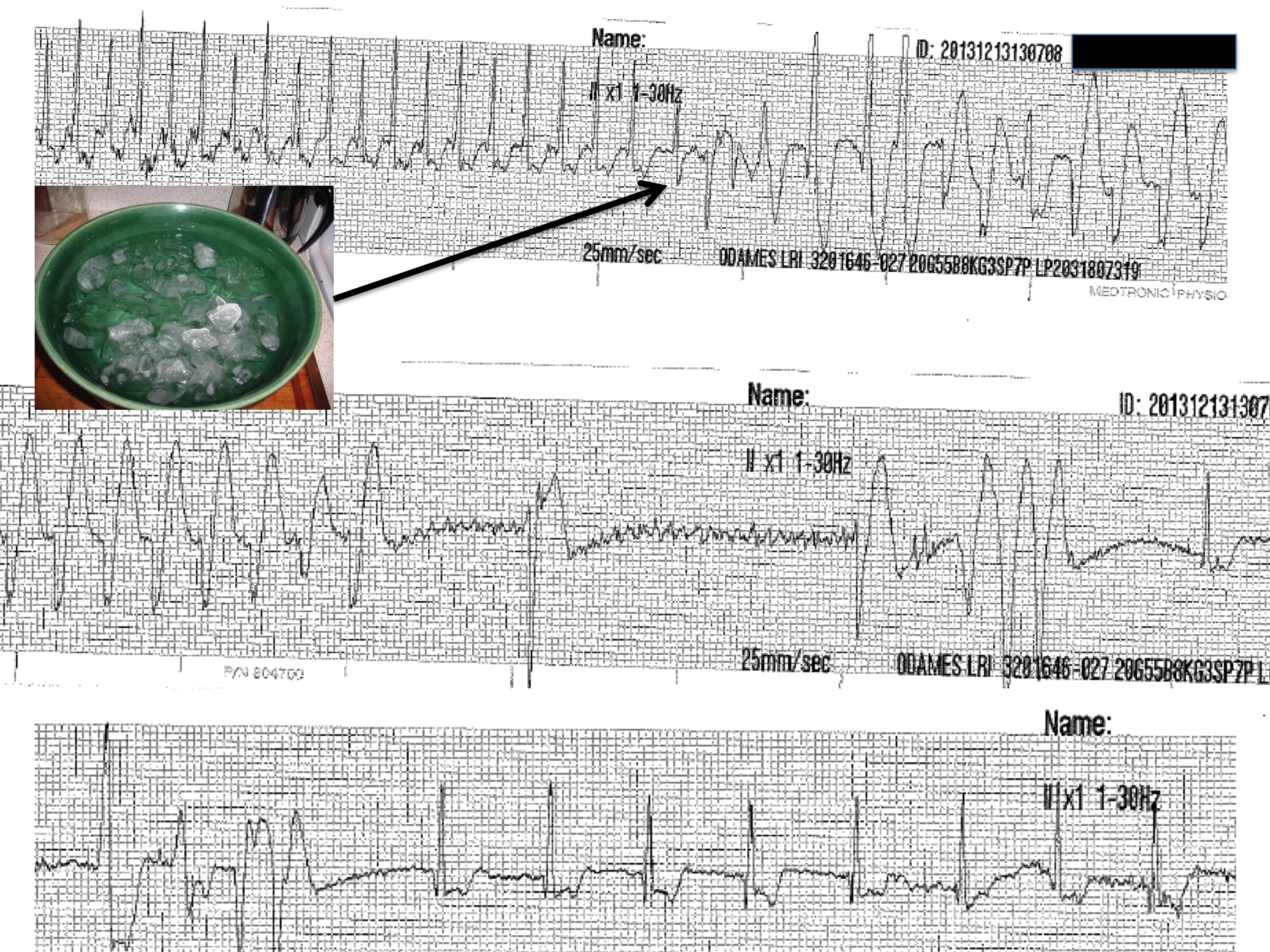
The ice bucket challenge: The best solution to SVT

Not one to waste an educational opportunity I used my ‘ice-bucket’ challenge video to talk about another use of ice-buckets…

SVT

Children in Supra-ventricular Tachycardia (SVT) are not uncommon presentations to Emergency Departments. It’s worth remembering that infants won’t present complaining of palpitations and may just be brought in by parents with poor feeding, irritability or just not being ‘right’. There is a really nice blog post about SVT  from Paediatric EM Morsels but I want to focus on one form of treatment – ice-water. I have yet not to have a child present who I have been unable to revert by this technique (It will happen I am sure…).

The key mistakes people make are:

1) Not holding properly. Young infants must be completely swaddled and have their face held in the water. This looks dreadful – so a lot of pre-warning to the parents is necessary.

2) They don’t complete immerse the face. It is not a slight ‘dab’ – the whole face must be immersed

3) They panic at 3 seconds.

In my experience you need a good 5s (sometimes slightly longer). This feels like a very long time (and is worse than the swaddled hold!) so you must brief parents (and other staff!) extensively about it.  Another approach is to basically hold longer than comfortable, and then hold a bit a more, if you don’t feel like counting in your head.

My ice-bucket challenge was to demonstrate what 5s feels like. Believe me if you can revert this way it is A LOT better than adenosine….

(Would have been better if I had thought through in advance what I was going to say but the light was running out fast…!)

[I have donated to the MND association]

What I learnt this week: #doctorwho would have no difficulty adopting a more managerial role #WILTW

This is the fifteenth #WILTW

The new series of #DoctorWho started in the UK last weekend. For those who aren’t aware, every so often the Doctor re-generates, taking on a new appearance and personality although keeping previous memories and skills. It’s a brilliant concept which in some part is the reason for the shows continued success.

Doctor Who

(photo via copyright free site http://www.fanpop.com/clubs/doctor-who/images/37459545/title/coleman-capaldi-photo)

In this series a new doctor is with us and more time than most is spent on the doctor reflecting on his new body:

“You know I never know where the faces come from, they just pop up. It’s covered in lines. But I didn’t do the frowning… Who frowned with this face?”

For the doctor’s companion the change can be hard to take, especially when a fanciable young man is replaced by a somewhat older model. The Doctor is the same person inside and pleads at the end of the episode to be considered no different from his predecessor:

“You can’t see me can you? You look at me and you can’t see me. Have you any idea what that is like. I’m right here. Please just see me…”

So what does this have to do with healthcare I hear you ask? Well at any given moment there will be a professional somewhere adopting a new role. Maybe involving more managerial or leadership responsibility, perhaps a step up a band level, or a move off a clinical rota. Often this person will be working with their peers, perhaps in exactly the same environment, but now have a ‘hierarchical’ responsibility for them. The person they are is no different, same skills and memories, but perhaps they might have to adopt a different personality. The buck, in management terms, now stops with them. This new ‘face’ is not always an easy mantle to take on. Whereas the doctor’s face changes completely – it is easy to think of them as a different person – for us non-Gallifreyans this isn’t an option. We should remember however the doctor finds the transition just as challenging.

hierarchy

It is worth both the doctor, and the newly promoted staff member, contemplating at the end of the day you are still the same person. It’s the characteristics of YOU that got you into this position and that will be your greatest strength.

“Have you seen this face before? No? Are you sure? It’s funny because I’m sure that I have…”

What have you learnt this week? #WILTW

EM isn’t child’s play when it’s Emergency Maths

New starters to paediatric wards, emergency departments and general practices around the country are faced with a huge array of formulas and equations to navigate. Most are relatively simple and require only a basic revision of multiplication tables. However some calculations are required in a time critical manner and anyone experienced in treating children knows how easy it is to make mistakes. In resucitation situations there may be many drug doses to calculate using some medications which may not be frequently used by the person prescribing them.

Given paediatric pharmacy is a very ‘mass’ based subject prompt calculation of weight is an essential first step. The traditional approach taken is that advised by APLS courses:

Weight 0 -1 = (Age/2)+4

Weight 1 -5 = (Age x2)+8

Weight 6 -12 = (Age x3)+7

There is a great blog from Simon Carley on the introduction of three equations rather than just one and the problems this may cause. The key point being does having three forumula increase complexity, and therefore risk of error, especially given we aren’t really sure what amount of difference in weight is clinically significant?  Other mechanisms of calcuating weight do exist, the broselow tape for example, but I especially like this one via Dilshad Marikar

(2010 APLS weight estimation) – Talking to the hand from Paediatric Tools on Vimeo.

The Leicester Hospitals Emergency Department have been working for sometime on a drug calculator for use in Emergency Situations. I’m very grateful to Dr. Mike Pearce, Dr. Mark Williams and Dr. Steve Corry for their hard work on bringing this to fruition. In the spirit of ‘FOAM’ we are sharing our efforts, not because we think it is any better than other systems out there, but because we are sure improvements can be made.

Drug Calculator

It can be downloaded by clicking LRI Paeds Drug Calculator v1.4. It’s been extensively tested and has the approval of our senior paediatric pharmacist. As with all such calculators we can not accept responsibility for its accuracy or ensure its currency.

Please let us know what you think via comments, @damian_roland or @em3foamed